
It’s no secret that writing is one of the most influential skills anyone can develop for thought leadership and for showcasing expert status on a topic.
Until recently, I’ve never thought of myself as a traditional writer. It’s my love of direct marketing that led me to write as much as I do today.
With marketing, there are always articles to write, ad campaigns, social media posts, and emails to send to prospects and customers. There is always content to create. It really is never-ending.
But it wasn’t until about a year and a half ago that Grammarly opened my eyes to how much I write. Grammarly is a software program that checks for grammatical errors in everything you write. This includes Word documents, social media posts, articles, emails, and anything else. It also has an app to check for errors when typing on smartphones.
You see, each Monday, Grammarly emails me a report that includes my top 3 errors. (My top 3 errors always involve violating some comma rule. Commas, those pesky little critters. :-), the number of words used, along with the number of words Grammarly reviewed each week.
The first week the report revealed that I had more than 18,000 words reviewed that week by Grammarly.
18,000 words?!
“What did I write?” is the question I kept asking myself.
The next week more than 22,000 words of mine were checked by Grammarly.
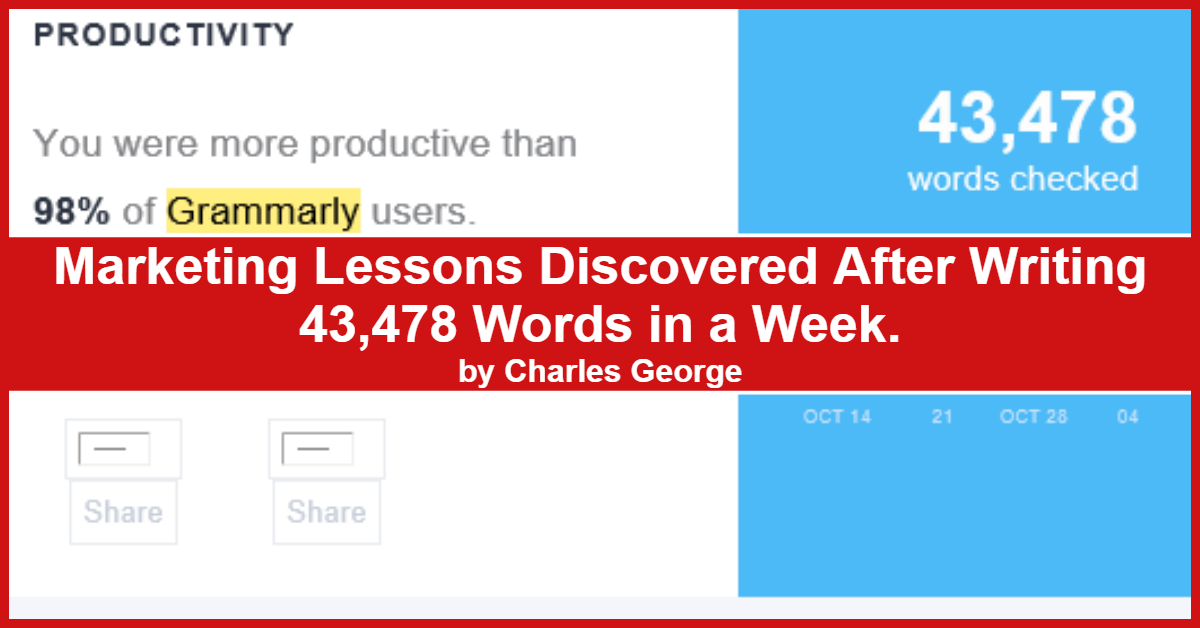
Not only that, Grammarly consistently reports that I am in the top 98% of all users for words checked each week. I average about 25,000 words checked by Grammarly each week.
Who would have thought? Certainly not me!
Now, I look forward to the report each Monday, if for nothing more than as a measure of productivity.
A couple of Mondays ago, the weekly Grammarly report showed that more than 42,000 words were checked, 42,500 words to be exact. I didn’t believe it. Surely, there must be some mistake.
The very next week, the report was 43,478 words of mine checked.
Now full disclosure, even though I was amazed that Grammarly reviewed this number of words in a week, my wrists and forearms were feeling the burn. It was like when you overexert muscles that aren’t normally worked quite as hard. The next day the muscles remind you that they were overworked. The same thing happened after writing this number of words for two weeks straight. My fingers, wrists, forearms, and elbows were screaming at me in protest.
So, after two weeks of receiving Grammarly reports of at least 42,000 words checked, I decided to investigate and answer the question I asked myself upon receiving the first Grammarly report 69 weeks ago.
What did I write?
Let’s start by listing different ways writing can promote a business.
Writing to Promote Your Business
Blog Posts – most of the blog posts that I write are between 800-1,200 words. My goal is to take one subject and explain it as thoroughly as possible so that readers can act. Plus, blog posts can be shared on similar sites to bring more traffic to a website. Blog posts are a great way to build authority and demonstrate expertise on a topic.
Social Media Posts – social media posts are good for creating engagement, staying top of mine, and for reaching new people.
Case Studies – case studies are success stories of clients. Normally they are about two pages long. When I write case studies, I normally follow this formula problem, solution, and then the result.
Media Buying Copy
Facebook Ad Copy– Facebook has built one of the most dynamic ad platforms available to author entrepreneurs today. Knowing how to write copy for Facebook ads is crucial to creating engagement, clicks, and opt-ins. The copy is what determines how successful the ads are.
Banner Ads– banner ads are still effective at generating traffic to your website, building an email list, and making offers. Banners can be placed on websites and within ezines, newsletters, and email.
Text Ads – Text ads can be placed in blog posts, on websites, and within emails. They can be used with Google ad words and with ad platforms that allow retargeting. Text ads can be highly effective.
Conversion Pages
Landing Pages – The copy on a landing page is critical. Good copy can mean the difference between a 15% opt-in rate and a 50% opt-in rate. The headline, sub-headline, bullet points, offer, call to action, etc. are all vital to the success of a high-performing landing page.
Sales Letters– sales letters represent the highest form of writing direct response copy. They require the most skill but can make a huge difference in the number of people who purchase a product. Sales letters can be presented as long-form sales letters online, video sales letters, and webinars.
Welcome emails– welcome emails are often the first action interaction with someone who has joined your email list. Often these emails establish the expectations for the relationship by letting the reader know how often they will receive emails, type of content, etc.
Newsletter articles – newsletter articles can be repurposed as blog posts. Normally, I include an article in every newsletter. I do this for several reasons. First, it provides value to my readers. Second, it gives readers a reason to open my emails. This ensures my email open rates remain high. Third, each newsletter provides value and helps my readers improve their businesses.
Autoresponders– Autoresponders can be promotional or dedicated emails that are automated. Often, they are triggered emails that are sent based on either an action or on a day and time. They can be used to indoctrinate a new subscriber to your list, promote products and build engagement. Dedicated emails can be repurposed as an autoresponder also.
Lift Notes/Dedicated/Promotional Emails– lift notes come from the world of direct mail. Lift notes normally work as an asset to the direct mail letter. The direct mail letter does the heavy lifting, and the lift note highlights the benefits or summarizes the offer. Often, I share stories when writing lift notes, but not always sometimes, it is a direct appeal of the product. Today lift notes are used online. They can be used in an email or posted on a website or blog to promote a product or service. They can also be used as promotional or dedicated emails.
Establish Authority
Reports– Reports are fantastic for establishing expertise on a subject. They can be used for lead magnets to drive email opt-ins or can be offered as a paid product that delivers valuable insights into a topic. Plus, they can be positioned as a bonus for a related offer.
Book – Today, a book is still the ultimate business card. Books can be a revenue source, establish authority, and can be used as a tool to build a business.
Now, the thread that connects each of these different types of writing, it’s marketing. Direct response marketing, to be exact.
As I said earlier, although I have never considered myself a traditional writer, I have been a student of direct response marketing for over 15 years. One aspect that I have focused on is writing copy. Writing copy is one commonality that connects each of the different types of writing I do each week. I do not write each of these listed every single week. I do focus on using my direct marketing skills and love for writing copy to build my business and earn money each day.


